

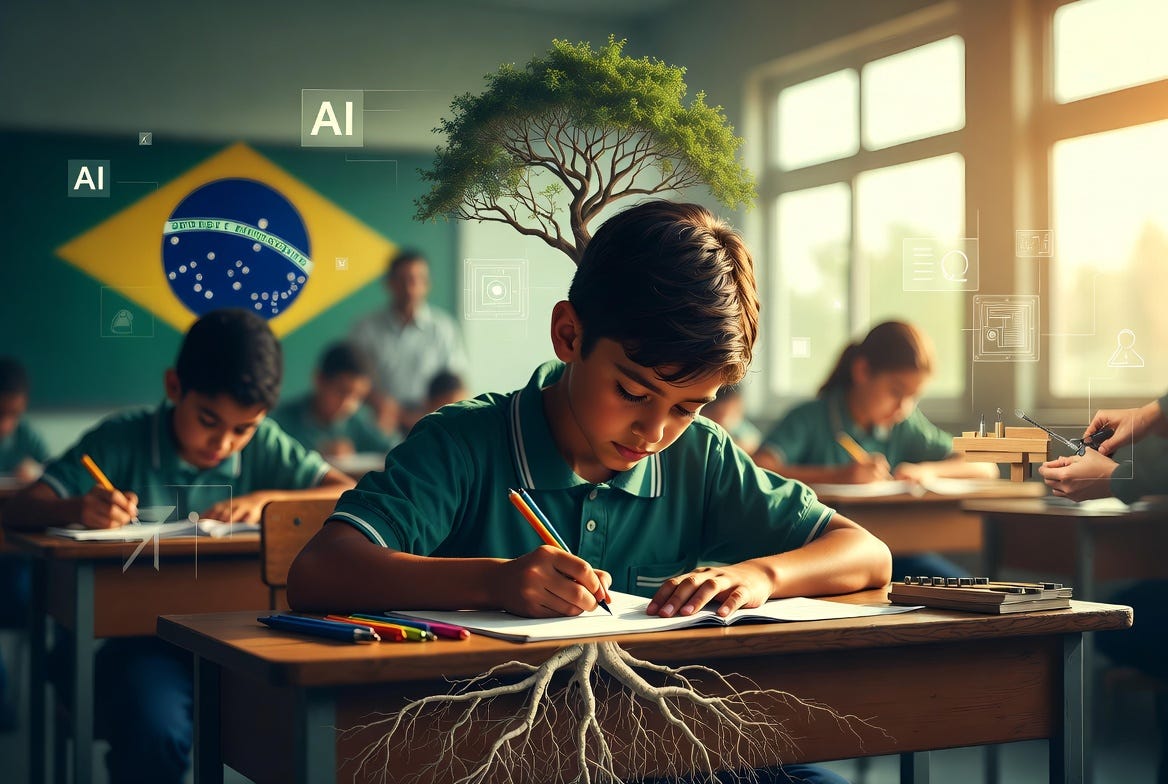
A few months ago I wrote to friends and family about what I saw at SXSW. I talked about human connection, self-knowledge, and the need to anchor our children in reality in a world increasingly full of synthetic noise. That piece was an appeal to parents, and you can read it here: SXSW, AI and the Future of Our Children.
This one started with a question from my sister in law, put to me very directly: what should schools change to actually prepare children for the world that is coming? Not the parents. The school.
The question stayed with me, but not because I think education is only the school’s job. Quite the opposite. I think we treat school and family like two teams playing separate games, when they should be on the same court, playing the same game. In fact, there are parents today who outsource that role to schools entirely, failing to do their part, which is the most important part. And one of the first steps to fixing that is bringing parents back inside the school in person, at meetings, at events, helping in the classroom when possible, instead of letting that relationship turn into an app that just delivers grades and absences in real time, with no human contact behind it.
The question every school should be asking right now is simple, even if the answer is not: which skills will survive the automation of thinking, and is the current curriculum training those skills or slowly killing them without anyone noticing?
Beyond tools like AI text detectors, which many schools have already adopted but which solve only a small fraction of the problem, here are some practical suggestions any school can put into practice now, without waiting for education system reform or heavy investment in new technology.
Computers and phones at school are silent enemies
Banning devices inside school until age sixteen is not nostalgia or authoritarianism, it is cognitive protection at a moment when the teenage brain is still forming the circuits responsible for sustained attention.
Every notification, every scroll, trains that developing brain to chase quick reward instead of depth, and a student who switches stimulus every eight seconds all day is unlikely to develop the capacity to stay stuck on a hard problem for thirty minutes. Solving a hard problem, with no shortcut and no instant reward, is exactly the skill that will separate those who thrive alongside AI from those replaced by it.
Handwriting and synthesis, again
Handing in handwritten work needs to come back as a requirement, not an exception, and along with it the old exercise of synthesizing content: a one page book summary, a one paragraph text summary, a handwritten reading log of a chapter.
Princeton researchers Mueller and Oppenheimer showed years ago that people who write by hand retain and understand better than people who type, because the hand is slower than the keyboard, and that slowness forces the brain to synthesize instead of transcribe. Synthesis is thinking, transcription is just copying, and that is exactly why asking a child to summarize an entire book in one paragraph, with no notes and no AI nearby, teaches something no automatic summarizer can teach: separating what matters from what does not, using their own judgment.
In a world where any text can be generated in seconds, handwriting and synthesis work together as a natural filter against invisible plagiarism. They do not solve everything, but they put the burden back on the student to run the idea through their own head before putting it on paper.
Colored pens as attention training
Requiring multiple colors in submitted work might sound like a small thing, but it is a powerful trigger, because forcing a student to categorize, underline, and highlight while writing trains a muscle that will be worth gold in the next decade: selective attention.
This can become something more structured, with methods like Cornell Notes, mind maps on paper, and color systems by category of idea. It is not about aesthetics, it is about teaching the child to organize their own thinking before an AI organizes it for them.
Mandatory two sided debate
This might be the single most important point of all. Students studying and presenting two contradictory points of view on the same topic train exactly what we are going to need most in the coming years: discernment.
I would take this beyond written text, into oral debate, with the student randomly assigned to defend the side they would not naturally choose. This trains intellectual empathy and also prepares kids for a world where any AI can generate convincing arguments for any position, true or false, and the child who learns to question their own conviction before accepting a ready made answer is one step ahead of someone who just absorbs whatever the screen delivers.
Resilience: letting the child solve it before rescuing them
One of the biggest problems I see today is the child who gets everything handed to them. Parents who resolve every friction with a teacher, every low grade, every conflict with a classmate, before the child even tries to solve it alone. That raises an adult unprepared for the first real obstacle of adult life, because they never trained the muscle of failing, negotiating, and pushing through without a middleman.
Here is a point I consider central and one that gets little discussion today: reducing the use of technology in managing the relationship between parents and teachers. Apps that notify parents in real time about every detail, from a test grade to a conversation in class, take away the child’s chance to learn to solve their own problems directly with the teacher or another school professional. There is real risk that the child hides something from their parents, at least until the next in person meeting, but that risk is worth it given the real gain in autonomy and resilience. A child who learns to go to the teacher, explain what happened, and look for a solution on their own is training exactly the muscle they will need once no one is left filtering the world for them.
Applied ethics, with the Talmud as a tool
Philosophy and ethics cannot be abstract subjects, disconnected from real life, and here I suggest something specific: using passages from the Talmud as the basis for these discussions.
The Talmud does not hand out ready made answers. It is built on dispute, on multiple rabbis openly disagreeing about the same case, on the idea that understanding both sides of an argument is part of the process of reaching the truth itself, and that structure, recorded debate, contradictory, with no forced consensus, is almost a manual of critical thinking written two thousand years ago.
Bringing real Talmudic cases into discussions of concrete dilemmas, like property, responsibility, and intent versus outcome, teaches the child that ethics is not a formula, it is trained judgment. And trained judgment is exactly what an AI cannot replicate on its own.
Family values, community, and patriotism
There is a dimension that almost never enters this debate and that might be the most important of all. School does not just form workers, it forms people, and a person without roots is easy to pull out of place.
In a world where AI is going to personalize every screen, every feed, every answer to each person’s individual taste, the risk is not just cognitive isolation, it is human isolation. A child who grows up with no sense of belonging, no loyalty to a family, a community, a country, is exposed, and becomes easy prey for any manipulation that offers false belonging in return.
That is why school needs to teach family values explicitly, not by accident: respect for elders, obligation to those who came before, responsibility to those who come after. It needs to teach real community life, with service, cooperation, and contact with the neighbor, with the local, with the concrete. And it needs to teach patriotism, in the healthy sense of the word, which means knowing your own history, understanding what was built for you to get here, and feeling pride and responsibility for it.
This is not indoctrination, it is anchoring. A child anchored in family, community, and country has solid ground under their feet, and solid ground holds up better against whatever storm the next decade of disruption brings.
Technical and vocational education back in high school
This point connects directly to what I wrote in the SXSW piece about getting your hands dirty. We need to bring back, with force, technical and vocational education, preferably manual, inside high school.
Carpentry, basic electrical work, mechanics, gardening, machine repair. It is not just about preparing a young person for a specific manual trade they could already make a living from by the end of high school, it is also about giving them real contact with physical consequence, work that does not run like code that can be redone with one click. A board cut wrong stays wrong, and that teaches responsibility in a way no theoretical class can.
There is also a direct economic argument here. Repetitive office jobs, the ones that live on processing information in predictable ways, are exactly the most vulnerable to automation, while jobs that require fine motor coordination, situational judgment in a physical environment, and real time adaptation hold up much longer. Raising kids only for office work is betting against their own future employability.
Grading the process, not just the result
If the final result of an assignment can be generated by AI in seconds, schools need to change what they grade, prioritizing drafts, notes, and oral defense of reasoning. The student needs to explain how they got to the answer, not just hand in the finished answer.
Takeaways
Summing up what a school can implement right now, without waiting for any education system reform:
Ban phones and devices inside school until age sixteen
Require handwritten work, including synthesis and summary exercises
Teach color coded note taking systems as attention training
Make oral debate with two contradictory sides mandatory, including random assignment of position
Reduce app use in parent teacher communication, encouraging children to resolve their own conflicts first
Bring parents back inside the school in person, not just as app users
Use real cases, including from the Talmud, to teach applied ethics
Teach family values, community life, and patriotism explicitly
Bring manual technical and vocational education back into high school
Grade process and reasoning, not just the final result
None of this depends on new technology or heavy investment. It depends on the courage to admit that today’s school model was built for a world that is ending, and on the will to raise children capable of thinking even when AI already thinks faster than they do, just not better.
My sister in law’s question still stands. The difference is that now it has an address, and that address is not just the school of the future, it is the school of right now.